Category: Finance

  • Four years as shareholder of Motherson Sumi System Limited

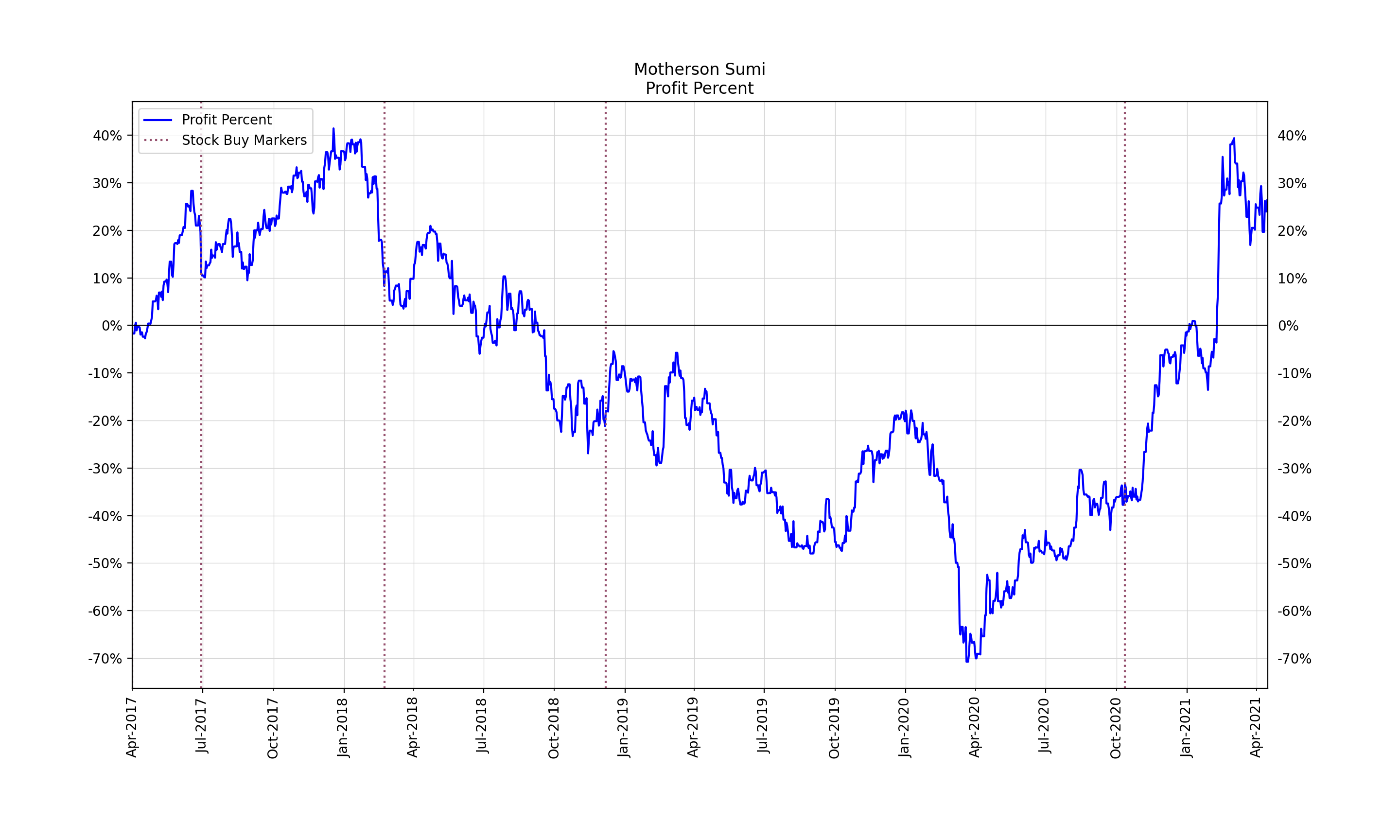
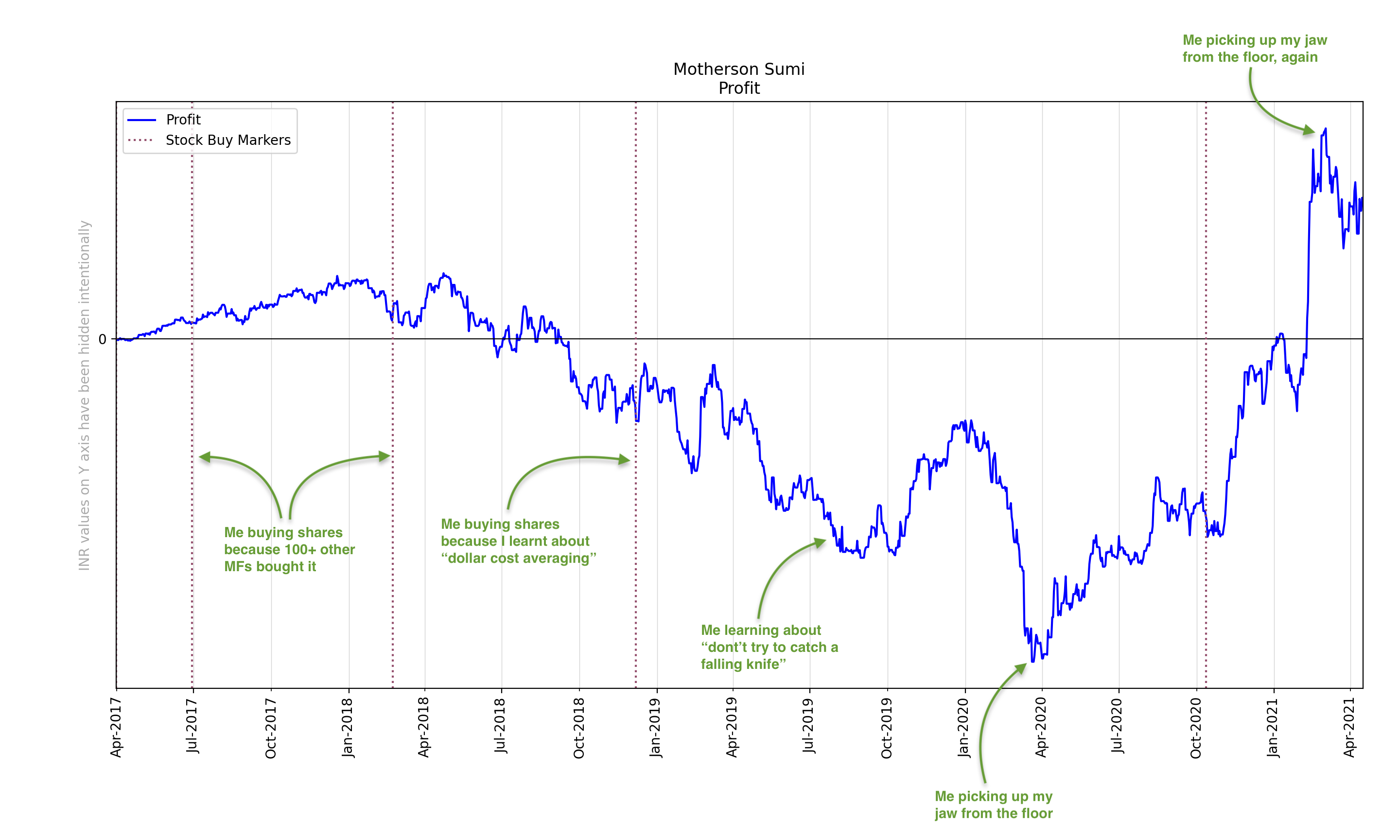
    Four years ago I didn’t know what Motherson Sumi System Limited was and what it did. The only reason I invested in it was that 100+ other mutual funds had invested in it. If so many mutual funds have invested in it, then the company must be good. That was the only research I did. 

    After learning about some thing called as “dollar cost averaging”, I invested more amount when the price fell. After the price fell even more I stopped investing as I learned something called as “don’t try to catch a falling knife”. 

    It has been a roller coaster ride on this one. In the crash of Mar-Jun 2020 the worth of my investment was just 30%. And in the subsequent months it recovered and returned to positive value after almost 3 years. 

    Return

    Profit
    XIRR
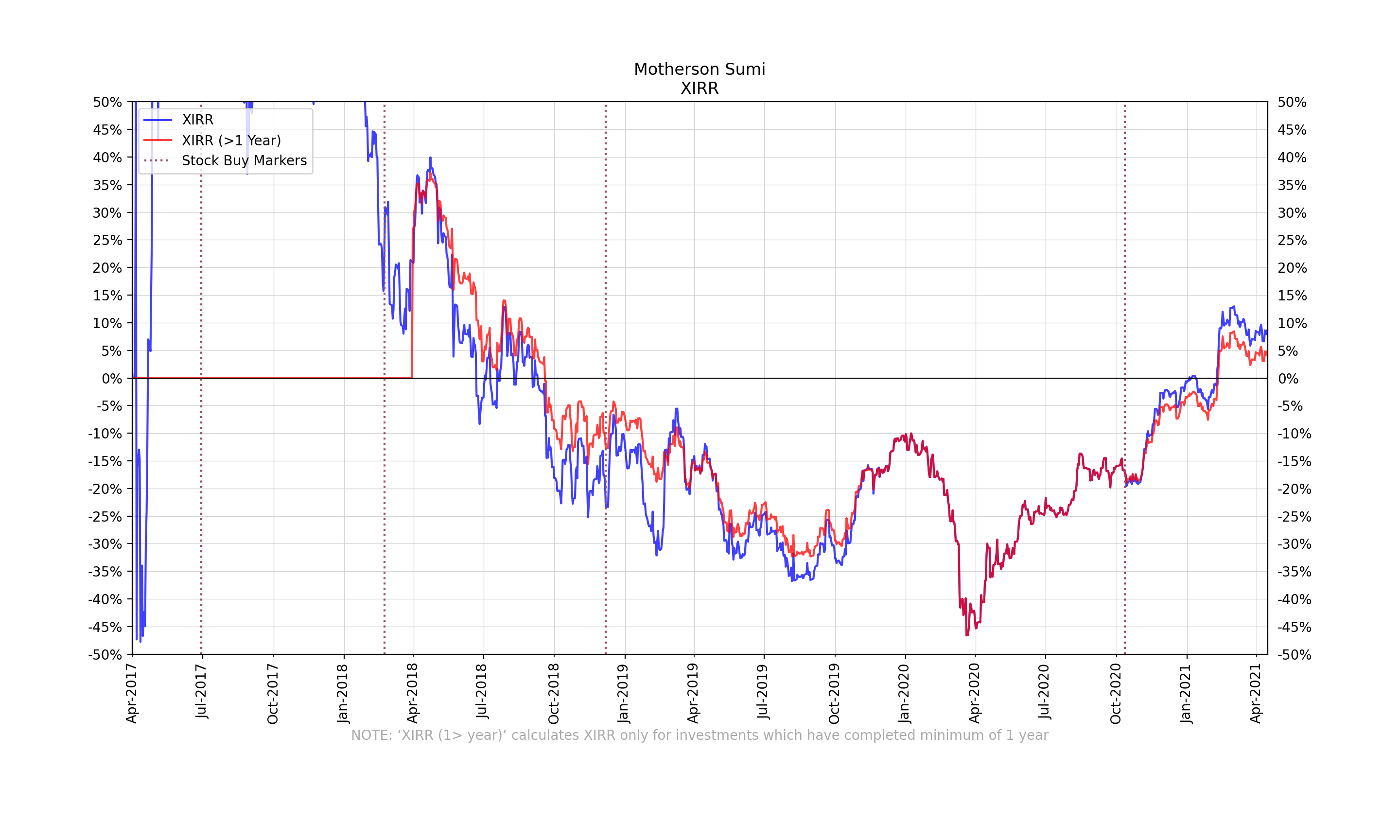
    NOTE: XIRR for initial months varies wildly and is not useful for any analysis. But once the investments complete minimum of 1 year, XIRR gives me a much better picture. So I calculate ‘XIRR (>1 year)’ which calculates XIRR only for the investments which have completed minimum of one year while ‘XIRR’ continues to calculate for all the investments irrespective of how much time has been completed. There are some periods where ‘XIRR’ and ‘XIRR (>1 year)’ calculate to the same amount as for that time all my investments had completed more minimum of 1 year.
  • Three years with Motilal Oswal Long Term Equity Fund

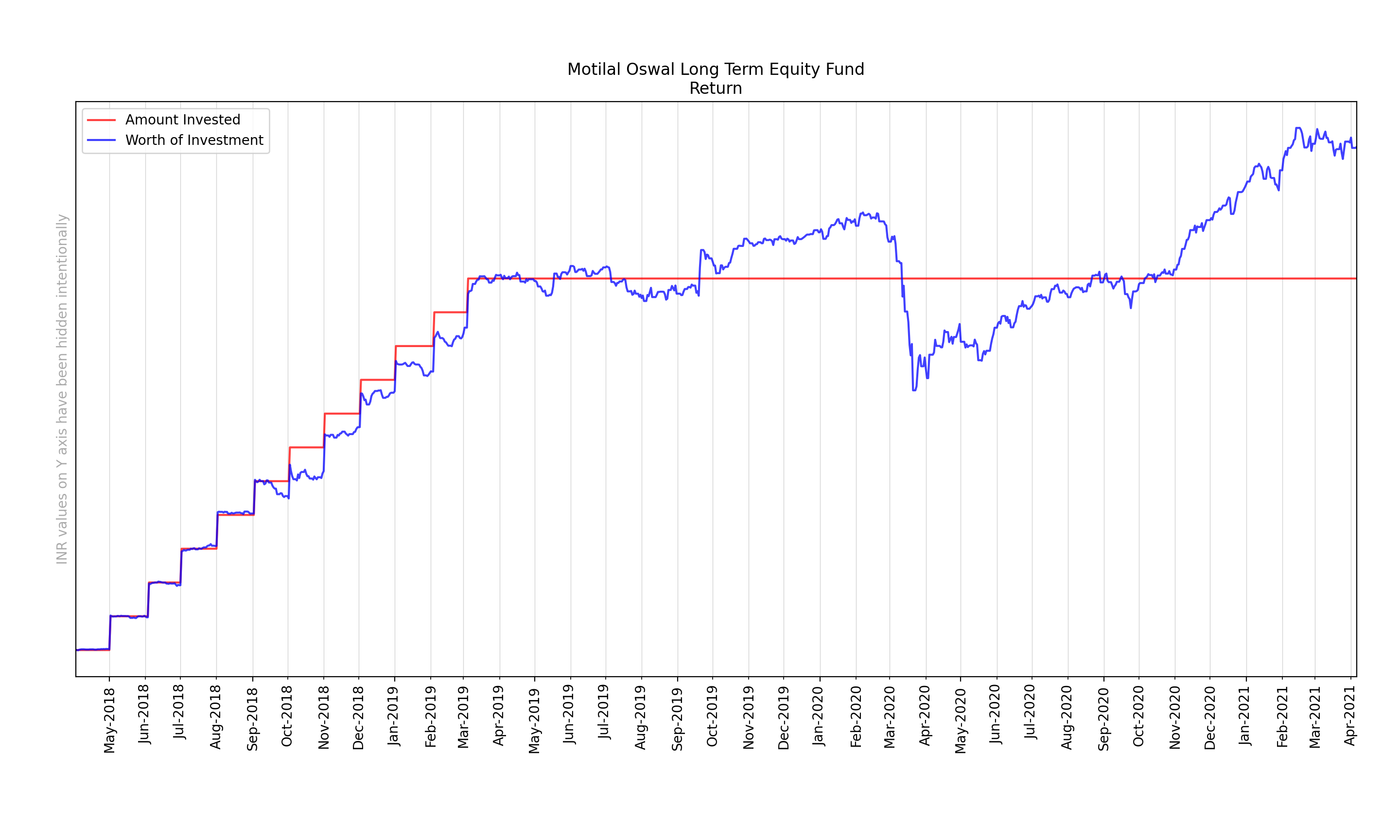
    Three years ago I went on a quest to save taxes by investing in something other than PPF. I invested in three ELSS funds and soon realised that it was too many. I have already blogged about my experience with DSP Tax Saver and L&T Tax Advantage. Here I will talk about Motilal Oswal Long Term Equity Fund, where I invested only for one year via monthly SIP.

    One significant activity during my SIP was that – this fund had invested in Manpasand Beverages and in May 2018, the auditor for Manpasand Beverages resigned sending the stock price into a free fall. I remember Motilal Oswal Fund sending an email explaining the situation.

    SIP Return

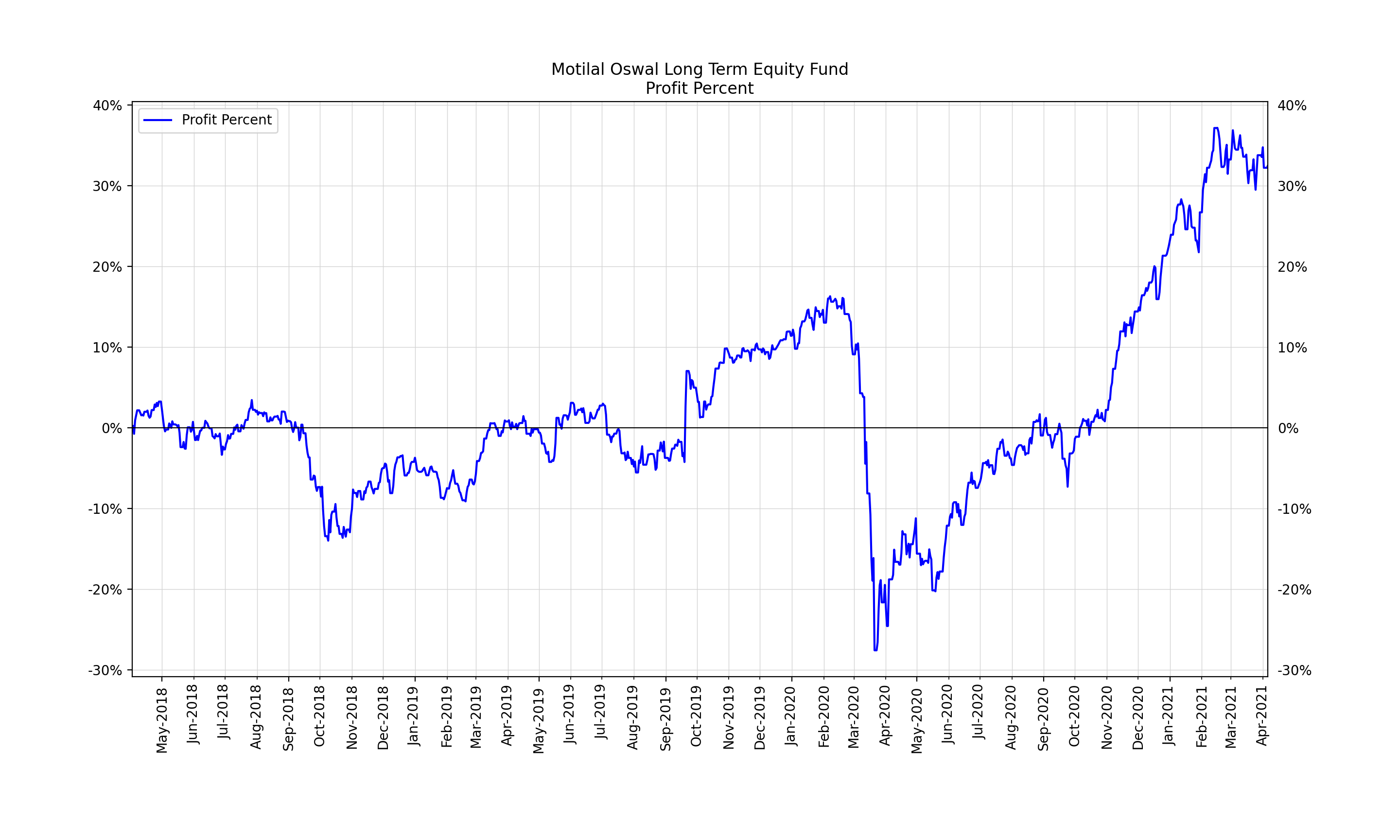
    I think, I think, the underperformance that started from Oct 2018 was a direct result of Manpasand Beverages fiasco.

    Profit

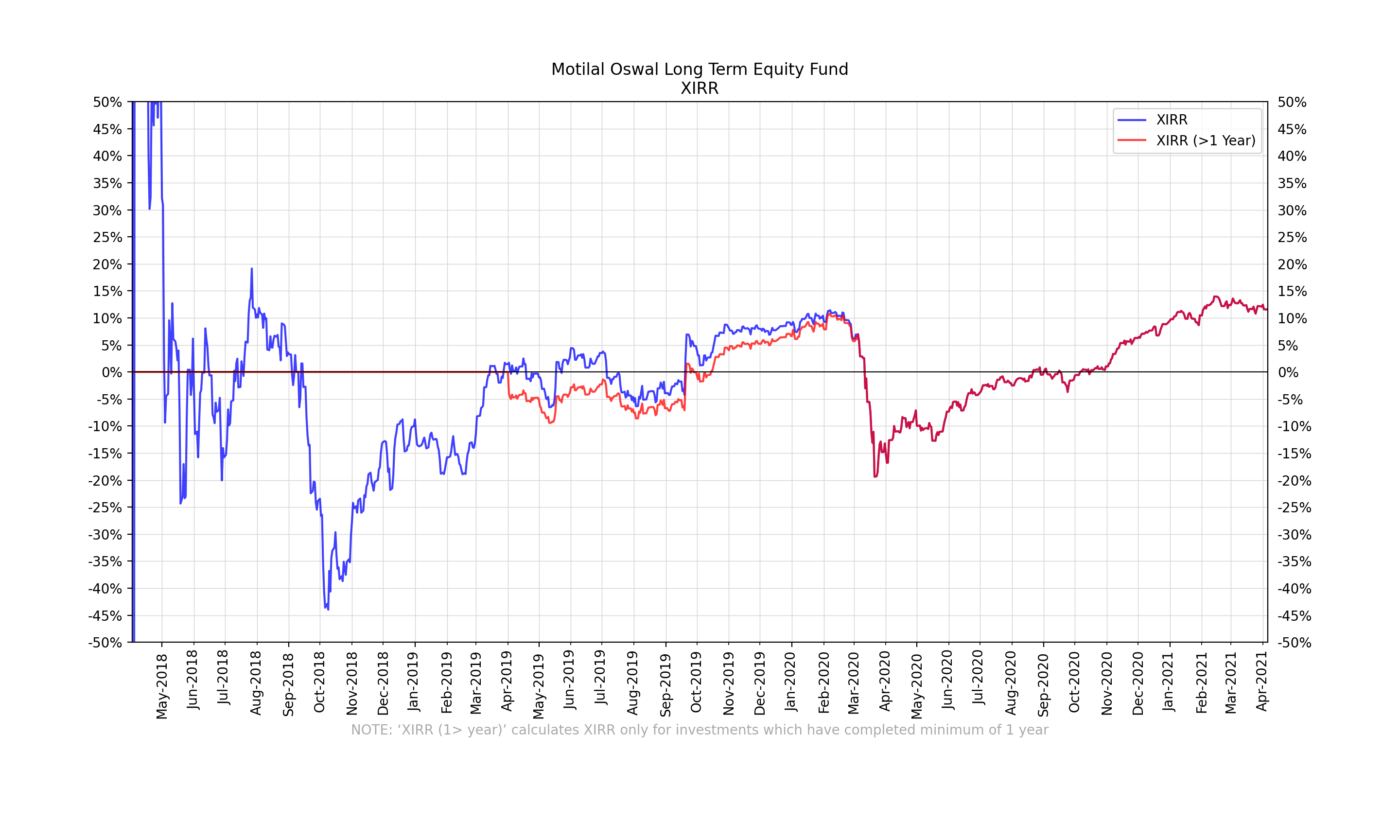
    XIRR

    I plan to sell off my entire holding in this fund by next year when all my units have completed 3 years and hope by that time the XIRR will have improved from current level of 12%.

    NOTE: XIRR for initial months varies wildly and is not useful for any analysis. But once the investments complete minimum of 1 year, XIRR gives me a much better picture. So I calculate ‘XIRR (>1 year)’ which calculates XIRR only for the investments which have completed minimum of one year while ‘XIRR’ continues to calculate for all the investments irrespective of how much time has been completed. There are some periods where ‘XIRR’ and ‘XIRR (>1 year)’ calculate to the same amount as for that time all my investments had completed more minimum of 1 year.
  • 3 years as shareholder of Supreme Industries

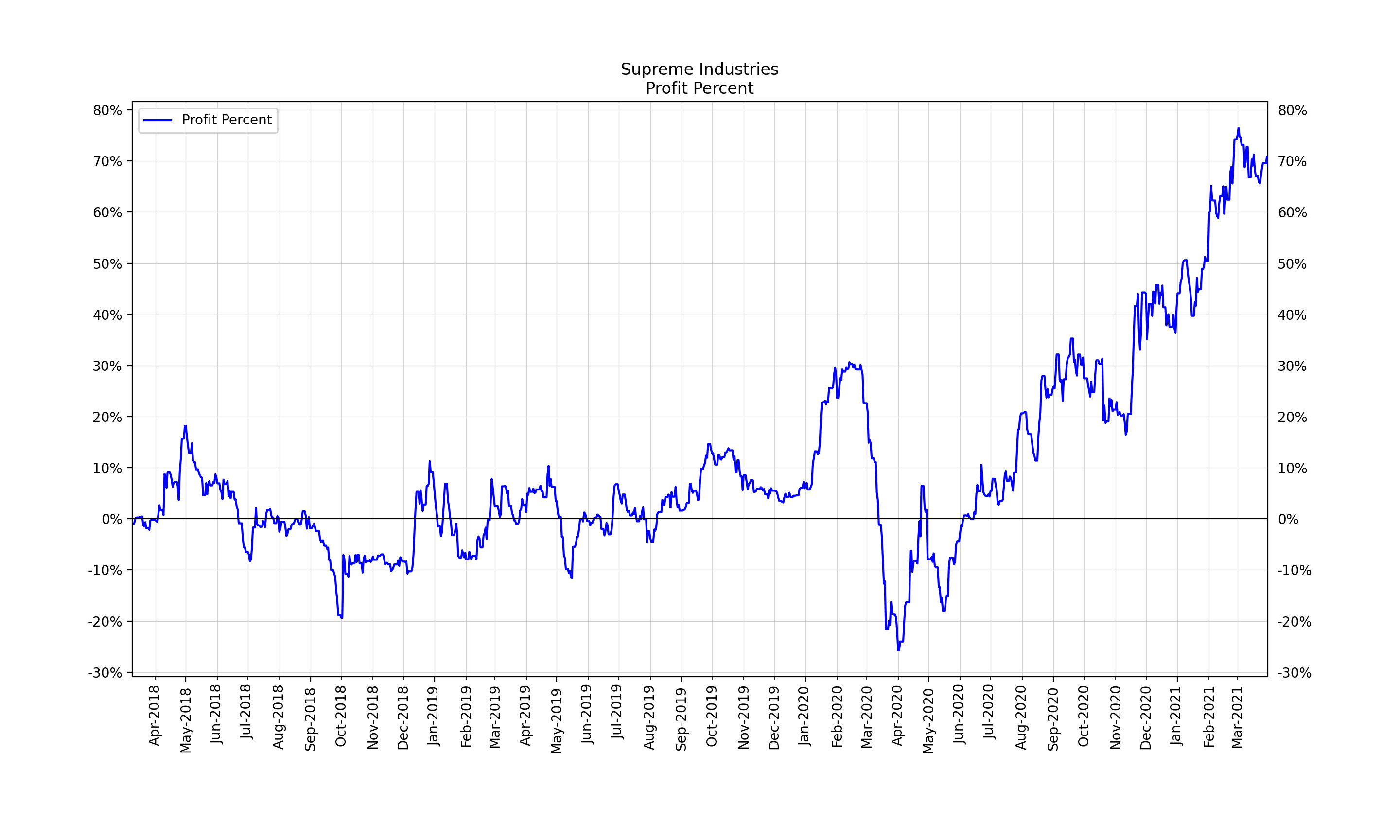
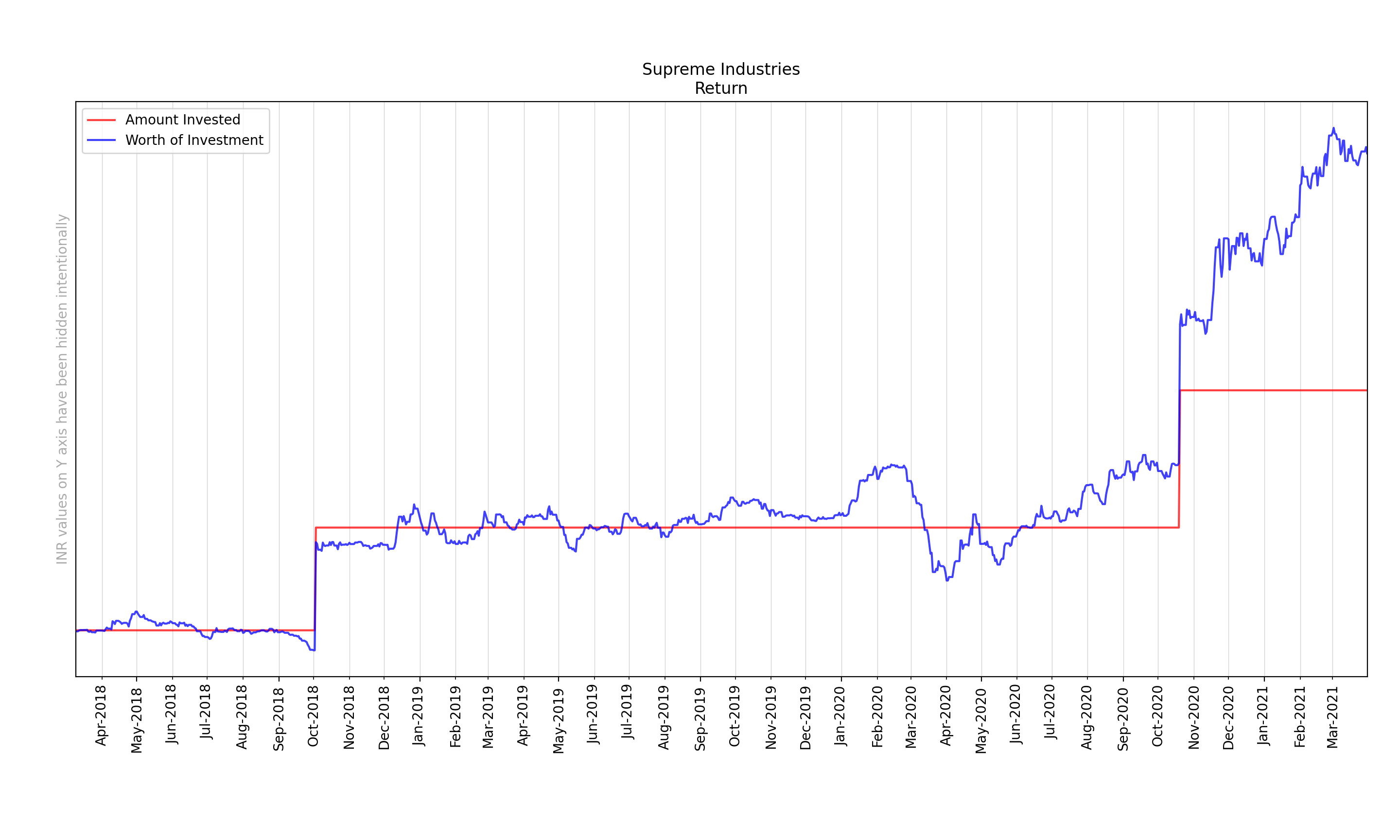
    3 years ago I invested in Supreme Industries after my thorough research (I bought a plastic chair made by Supreme Industries and I liked it). After that I invested just two more times in the stock. Below is how the stock has performed for me over these 3 years.

    Return

    For first two years, the returns were pretty average. It was only during the uptick post Jun 2020, the stock has risen sharply and delivered good returns.

    Profit

    XIRR

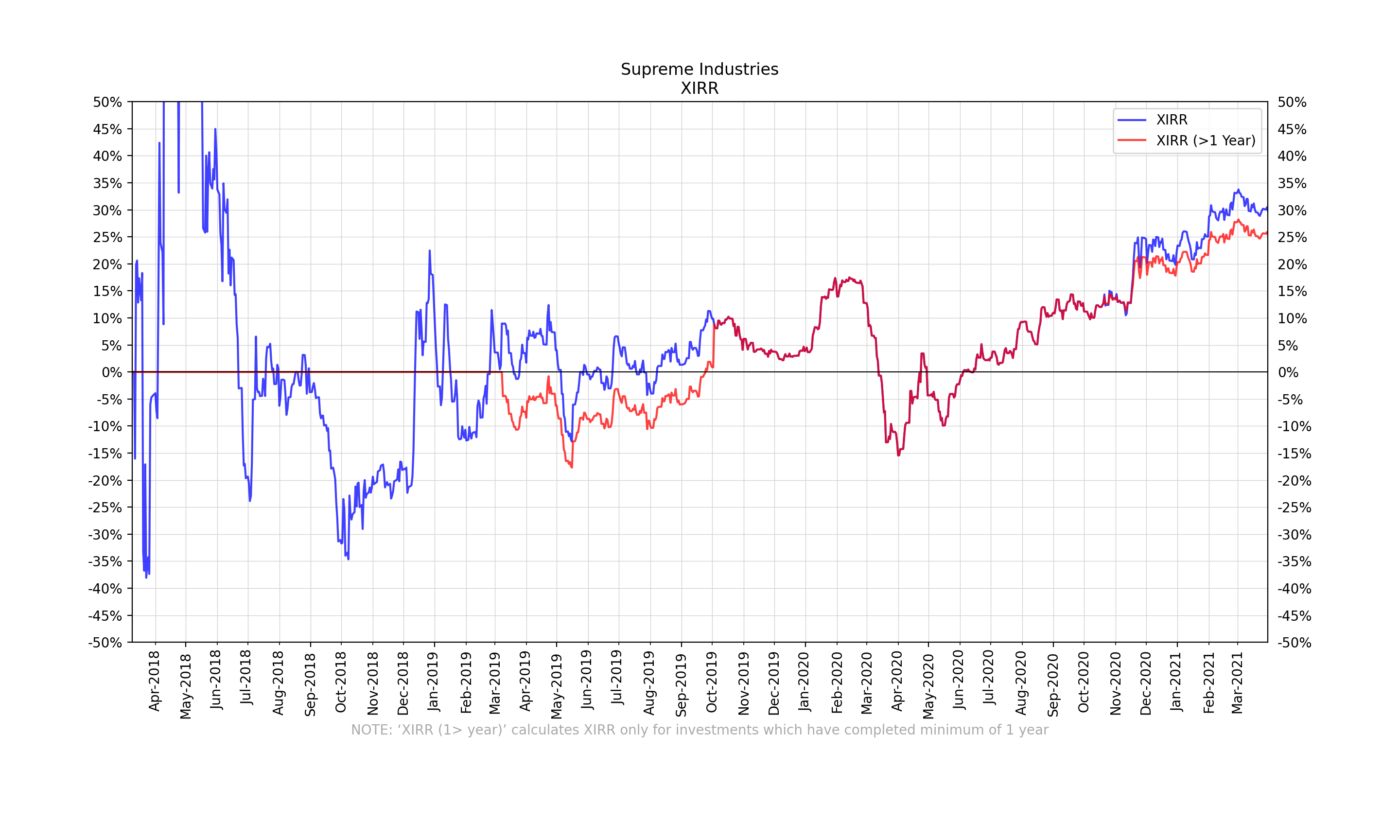
    XIRR for initial months varies wildly and is not useful for any analysis. But once the investments complete minimum of 1 year, XIRR gives me a much better picture. So I calculate ‘XIRR (>1 year)’ which calculates XIRR only for the investments which have completed minimum of one year while ‘XIRR’ continues to calculate for all the investments irrespective of how much time has been completed. There are some periods where ‘XIRR’ and ‘XIRR (>1 year)’ calculate to the same amount as for that time all my investments had completed more minimum of 1 year.
  • 4 years as shareholder of Greenply Industries

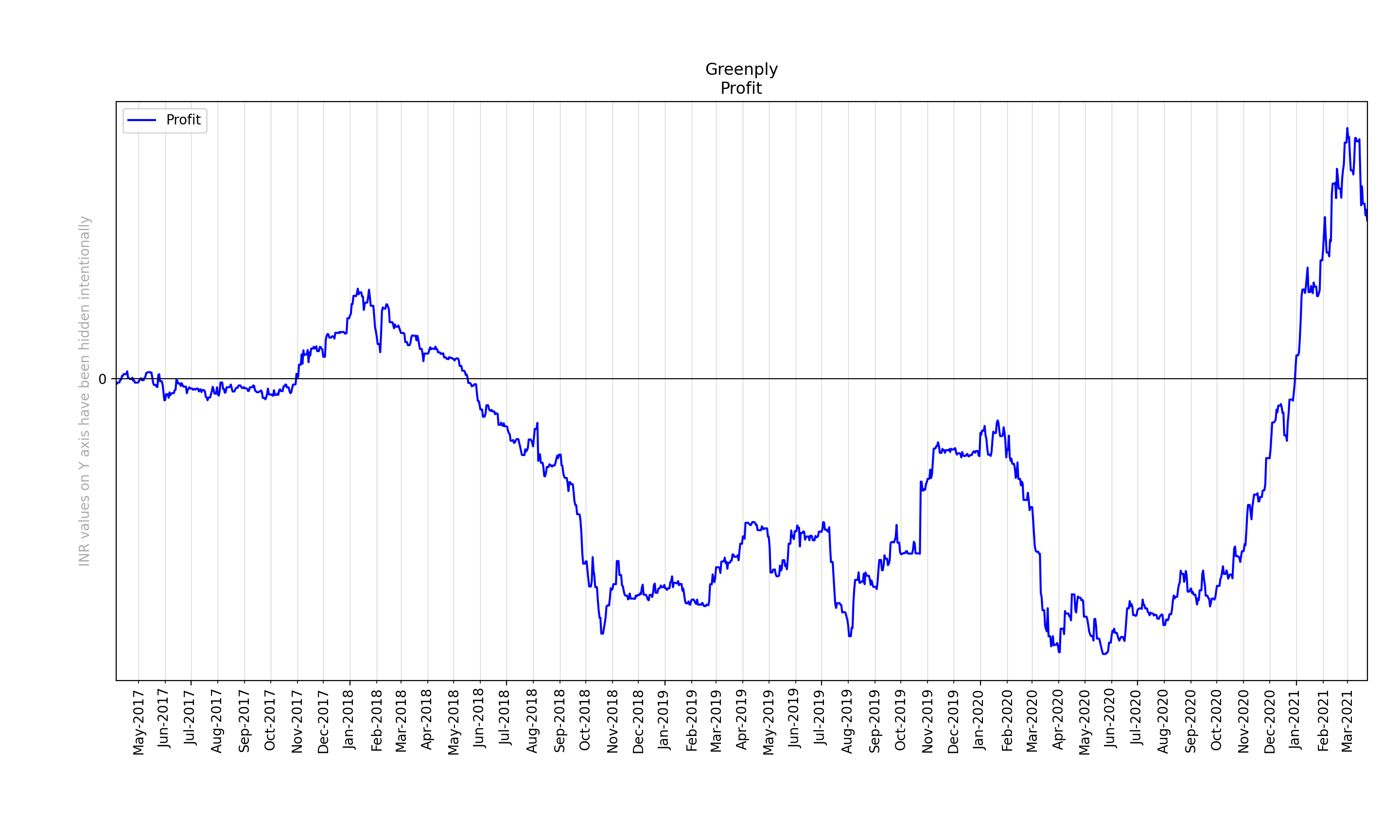
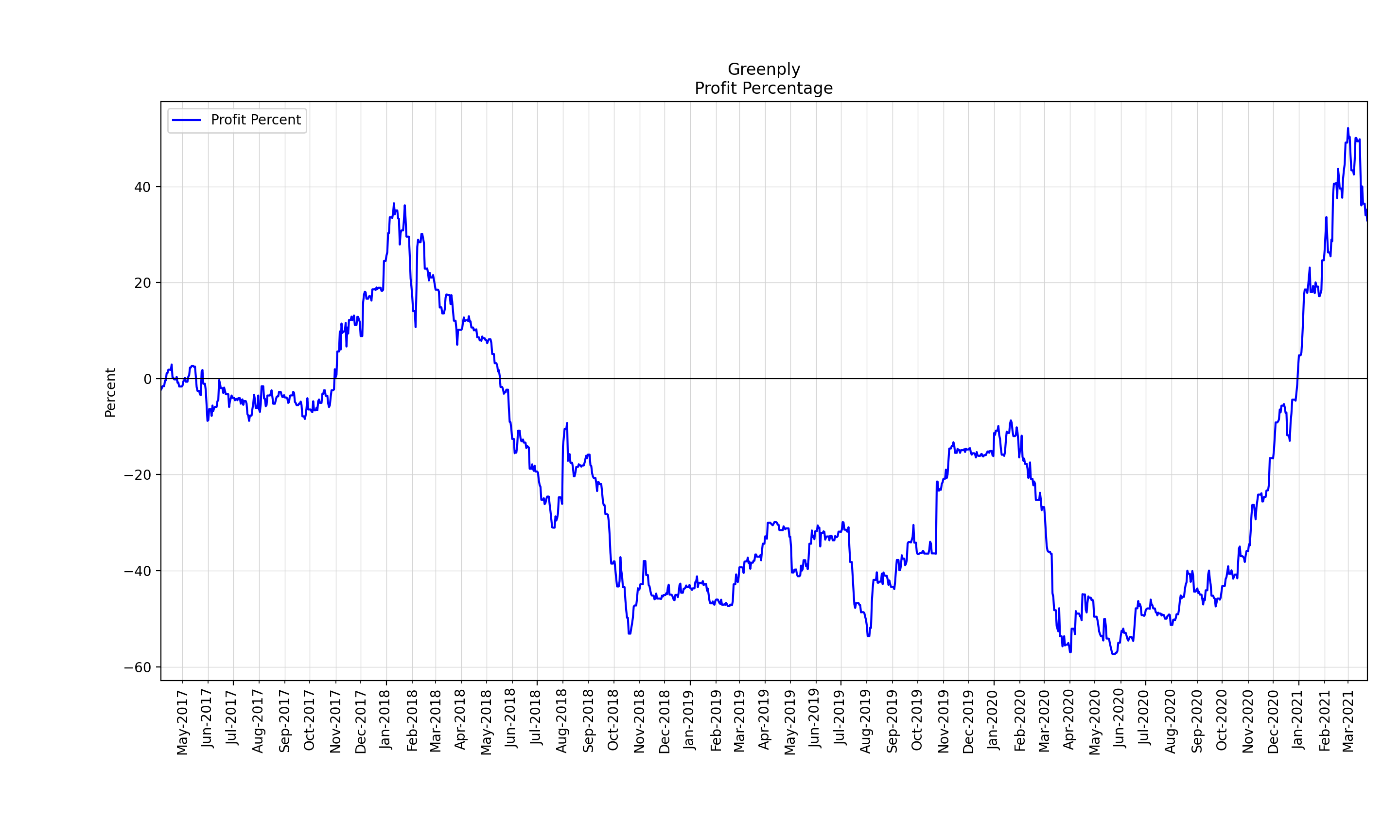
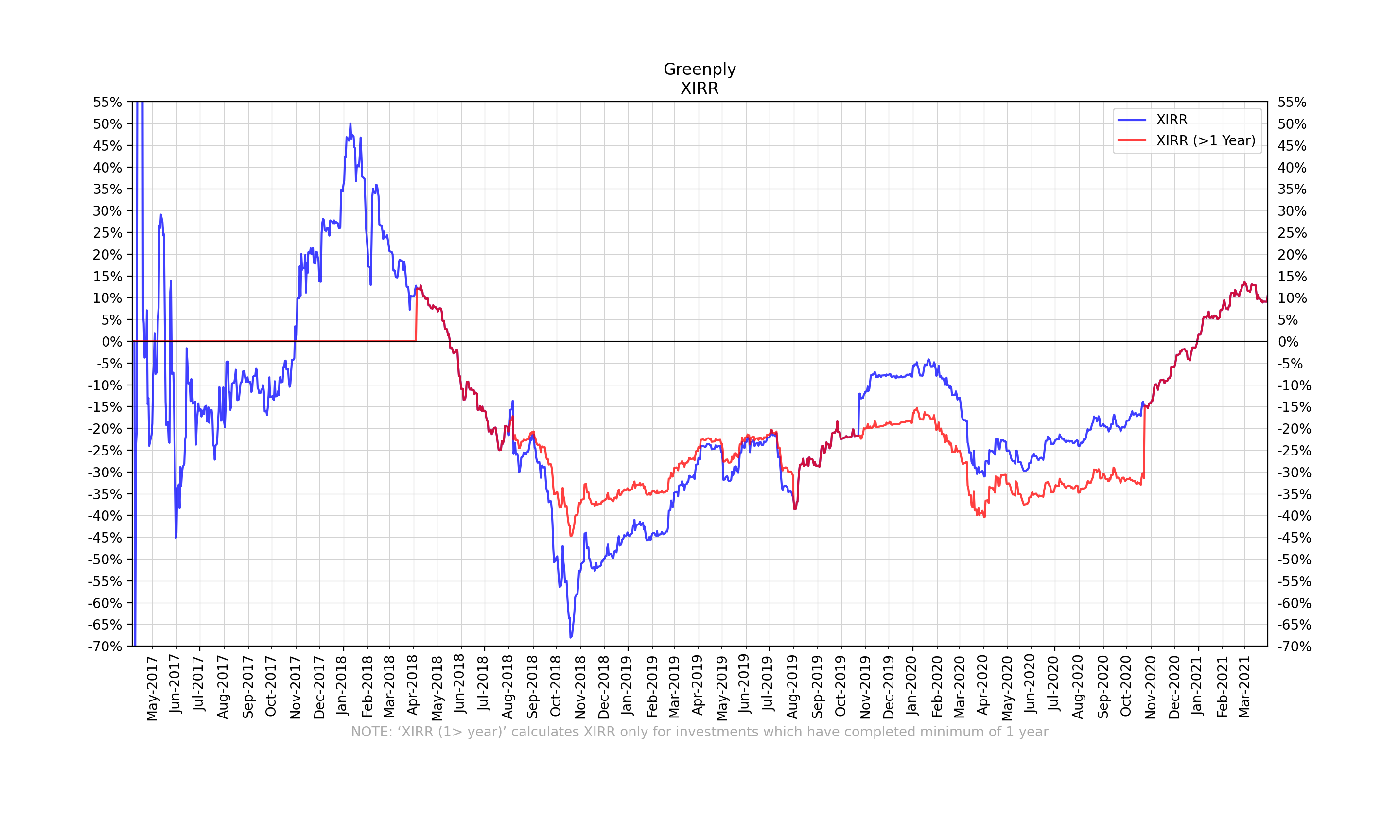
    4 years ago I invested in Greenply Industries after my thorough research (and I can’t remember what that research was). Over these 4 years I invested only two times. The result were underwhelming until Greenply spun off the medium density fibreboard (MDF) business into Greenpanel Industries and gave me Greenpanel shares in the ratio 1:1. Last one year of rise is all thanks to Greenpanel’s share price rally.

    Return

    The sharp uptick in Oct 2019 is due to me getting Greenpanel shares in 1:1 ratio.

    Profit

    After Jun 2018, I was able to see the worth of my investment in green only after Jan 2021.

    XIRR

    I think there is some problem with my XIRR formula, seems like if the worth of my investment goes down below a certain mark the XIRR simply calculates to zero.

    Update 5-Apr-2021: I was able to figure out the problem with my XIRR and fix it.

  • 4 years as shareholder of IDFC First Bank

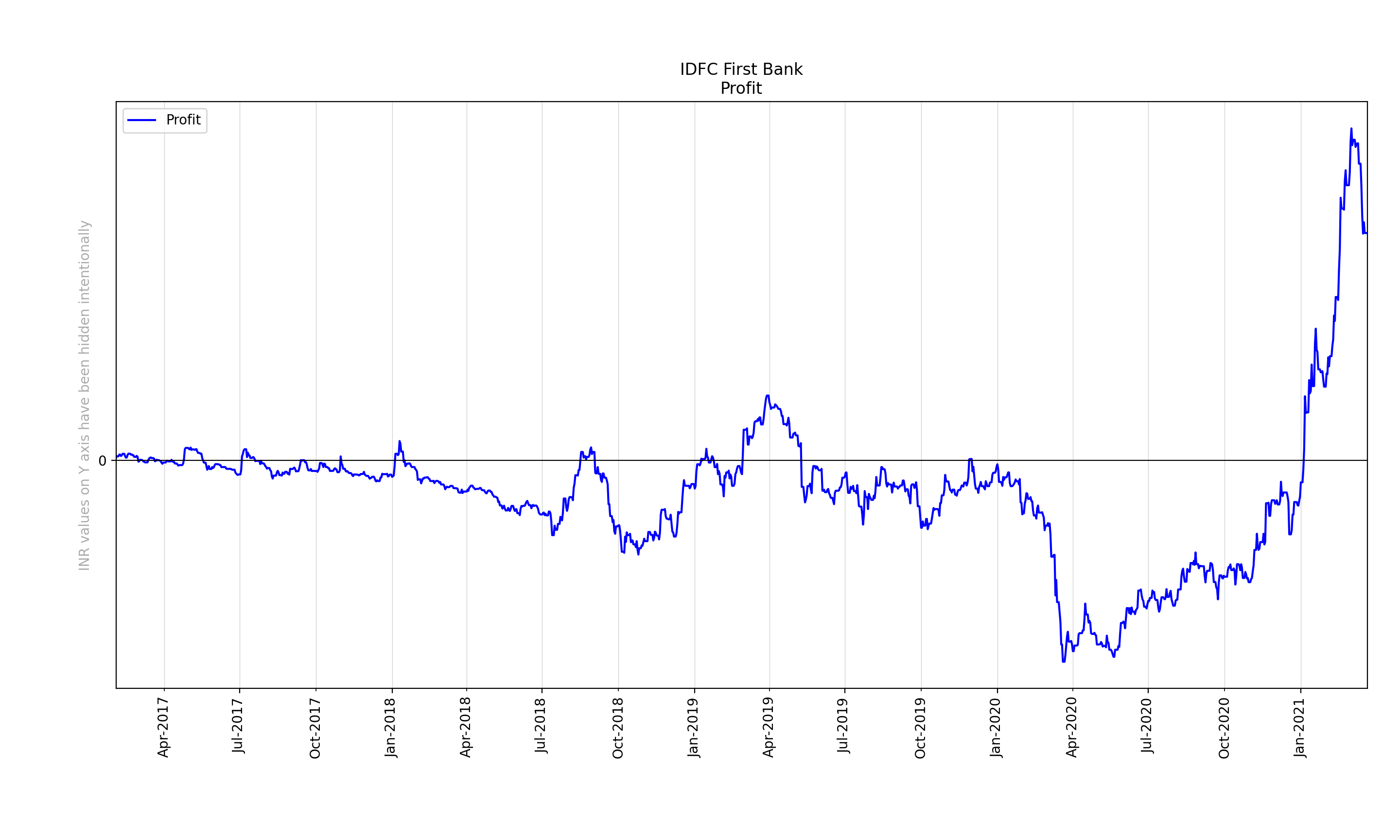
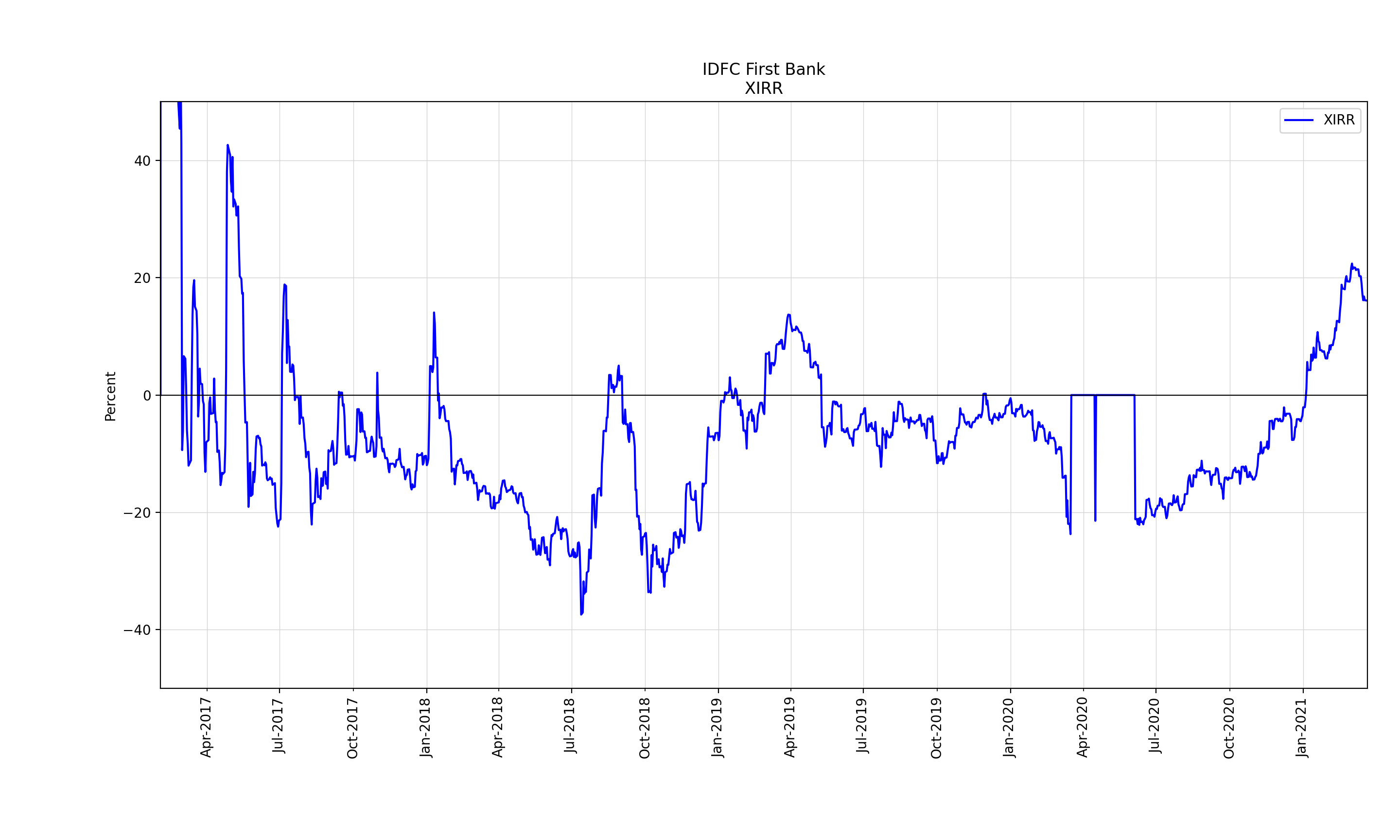
    4 years ago I invested in IDFC First Bank after my thorough research (raj_king on MoneyControl.com forum told that IDFC Bank will become the next HDFC Bank. I am now hoping that HDFC Bank will rename itself to HDFC First Bank).

    Over these 4 years I invested only three times. For the majority of time, the worth of my investment has been less than the amount invested. It is only from Jan 2021 I have seen profit. And I don’t know how long will that sustain.

    Return

    Profit

    XIRR

  • 3 years with DSP Tax Saver Fund and L&T Tax Advantage Fund

    3 years ago I decided to start investing in an ELSS fund, apart from PPF, to save taxes. After a thorough research (eeny, meeny, miny, moe), I decided to go with DSP Tax Saver Fund and L&T Tax Advantage Fund. I went via the SIP route. My first couple of instalments were in Regular plan before realising that there is something called as Direct plan which has lower expense ratio (thank you Economic Times). Below are the key steps that I did over last three years.

    1. Started SIP in April 2018
    2. SIP frequency was monthly
    3. Increased SIP every year
      • DSP Tax Saver
        • Apr 2019: + 60%
        • Apr 2020: + 87.5%
      • L&T Tax Advantage
        • Apr 2019: + 20%
        • Apr 2020: + 16.7 %
    4. If I had surplus funds in a month, then I used to invest them in the fund as lumpsum. Being one of the lucky folks who did not lose his job due to pandemic (no increments though), I was able to invest surplus amount during the blood bath in stock markets of Mar-Jun 2020.

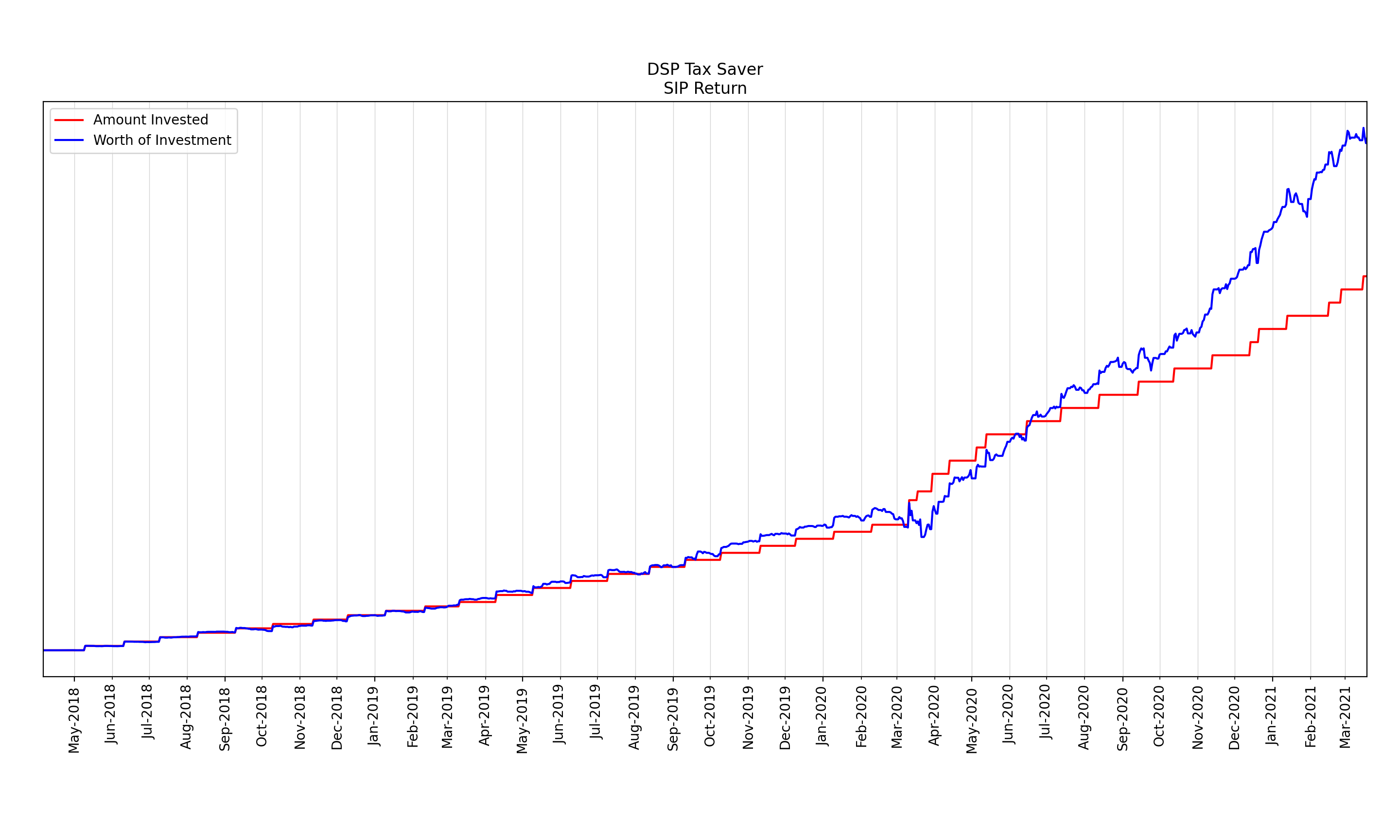
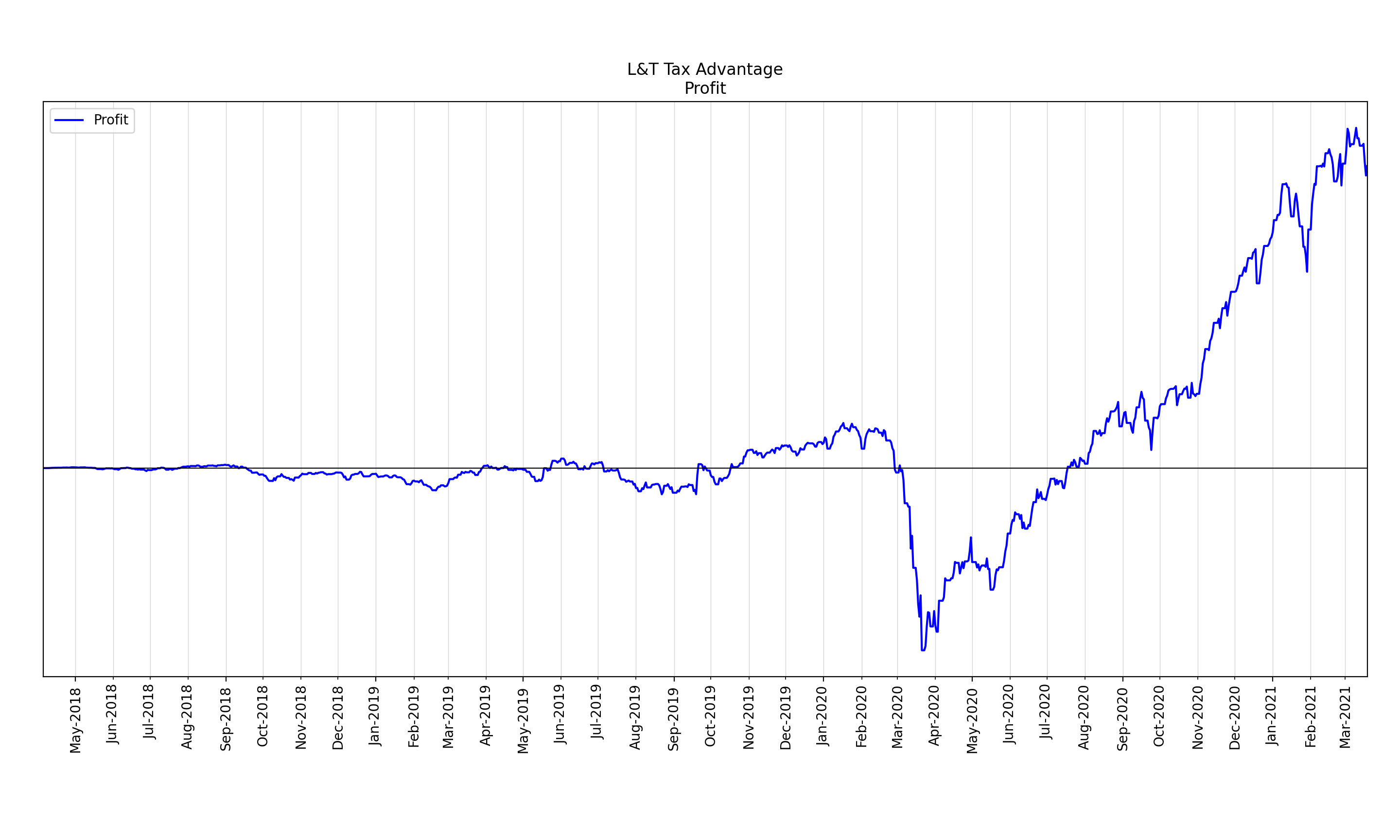
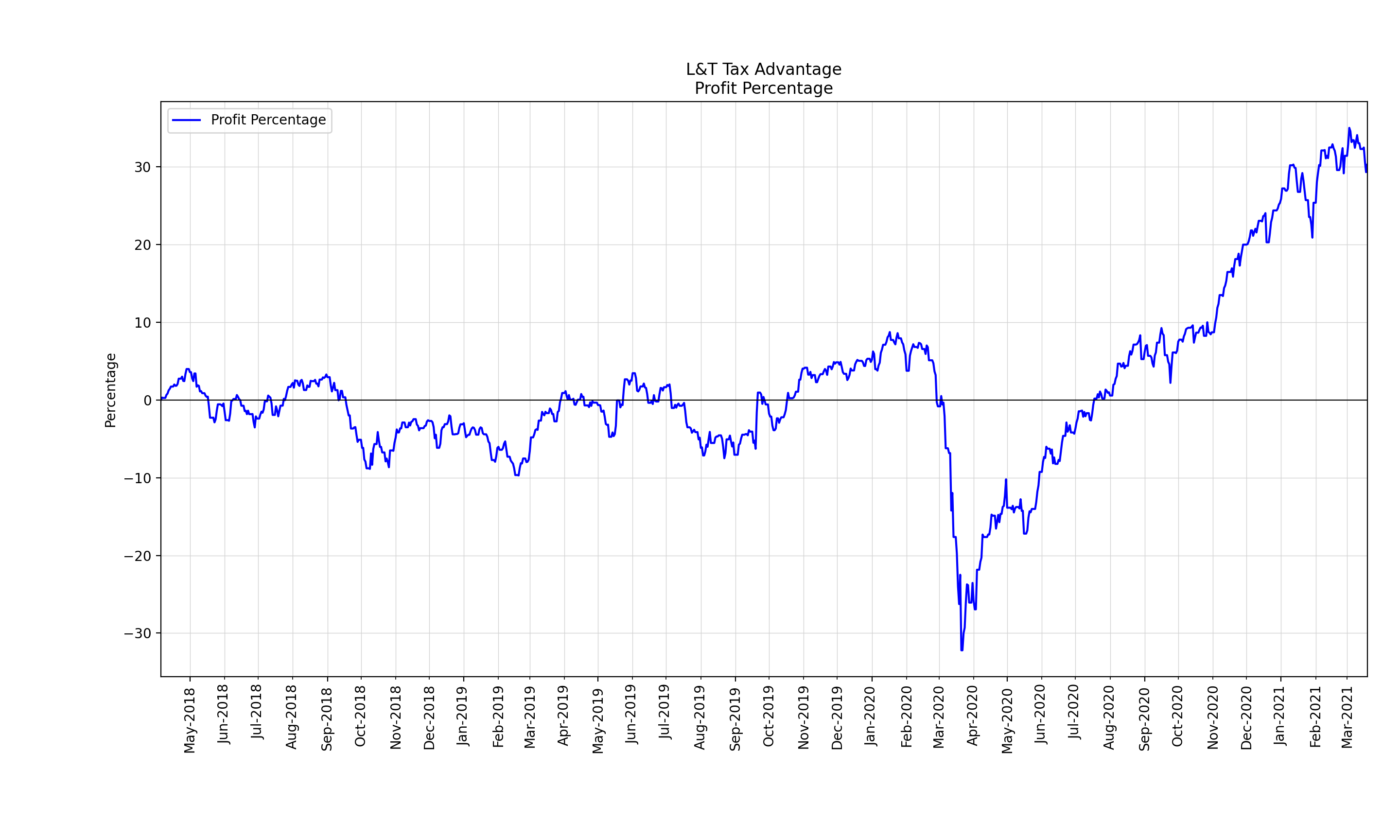
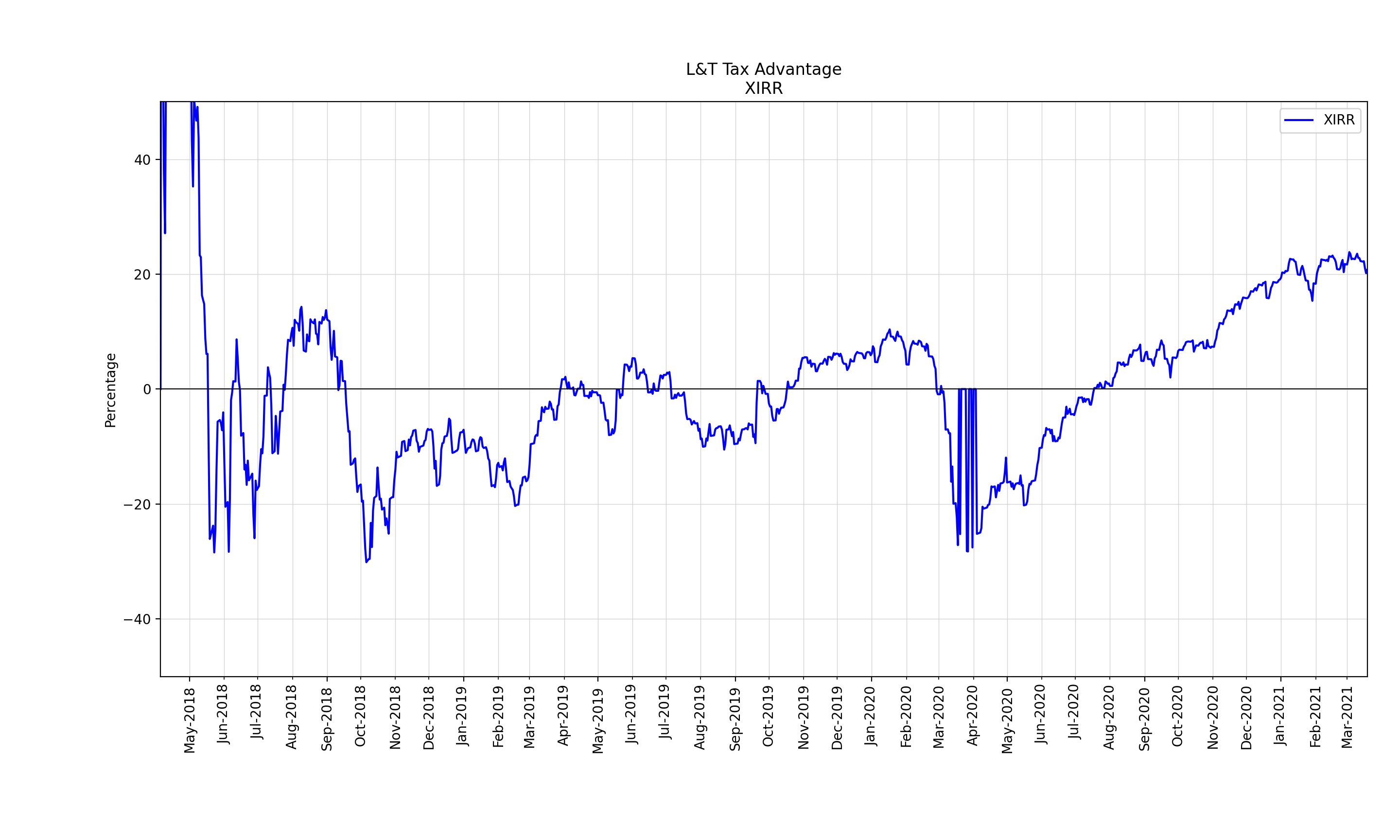
    I have plotted the SIP Return, Profit and XIRR of both these funds from April 2018 to Mar 2021.

    DSP Tax Saver Fund

    SIP Return Chart

    From Mar to Jul 2020, I was able to invest additional fund as lumpsum, that’s why the steps are not uniform as they were in previous two years. I continued investing lumpsum after wards also, albeit less frequent, as the market seemed to be very expensive.

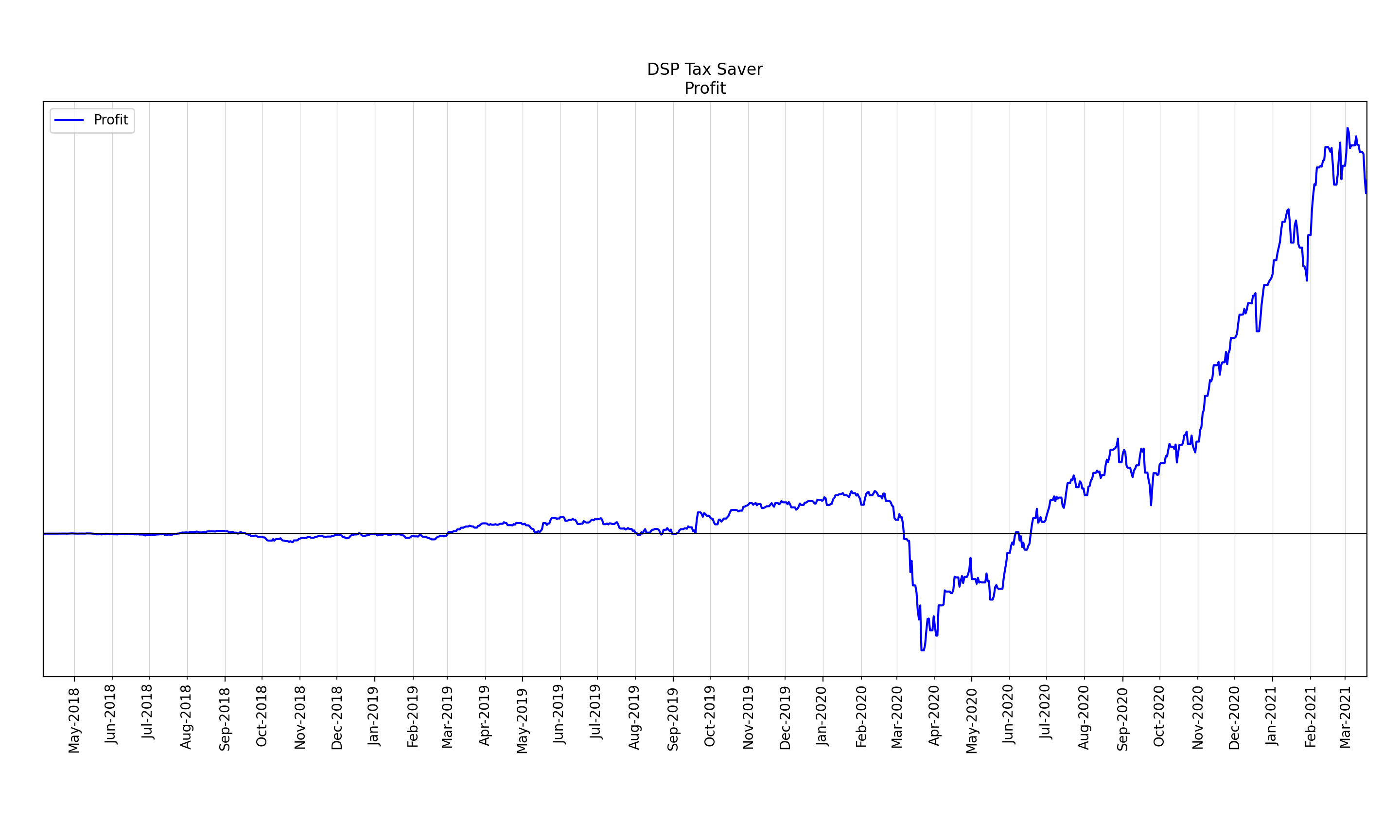
    Profit Chart

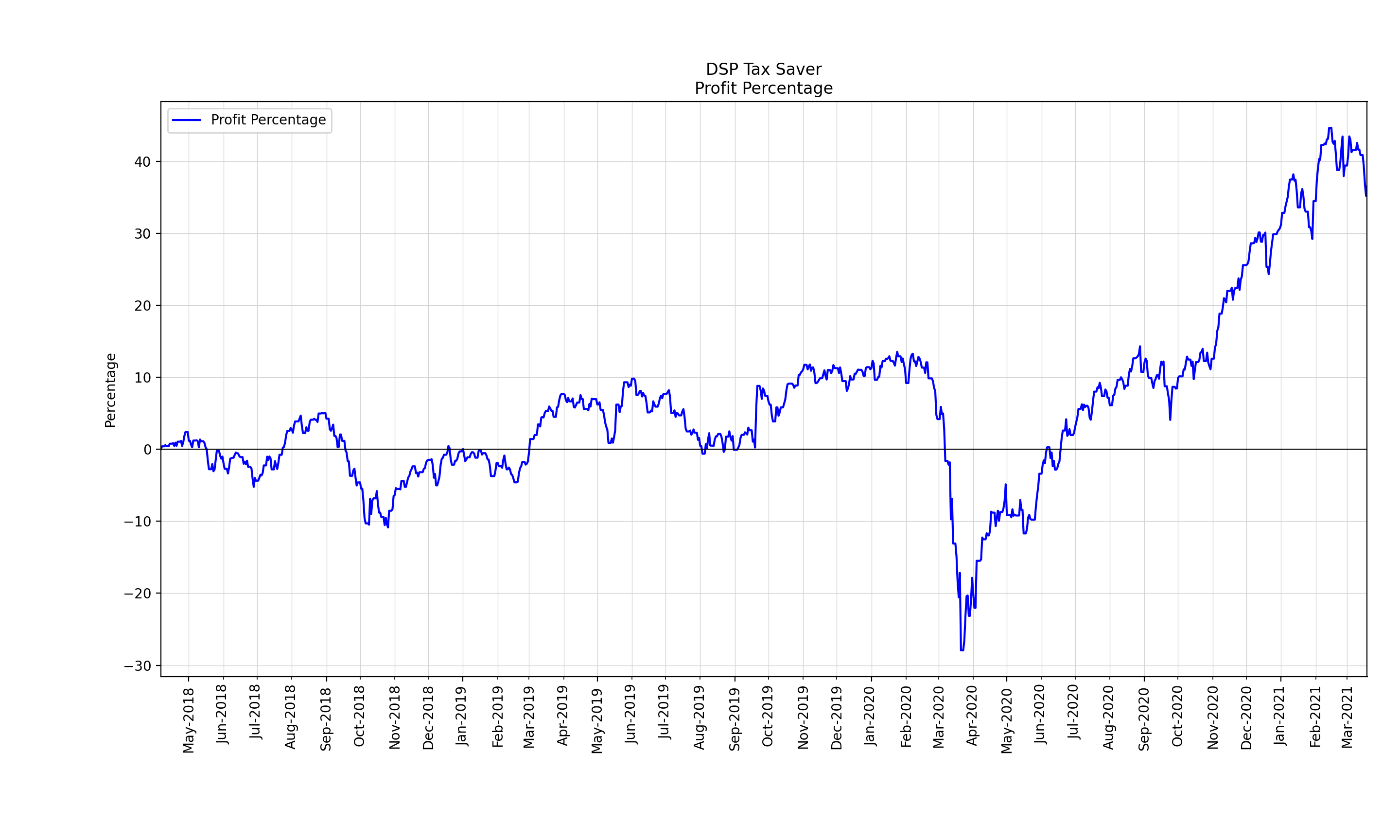
    During the market crash from Mar to Jun 2020, two years worth of my investments went down by ~28%. But as of Mar 2021, I am looking at a profit of ~35%.

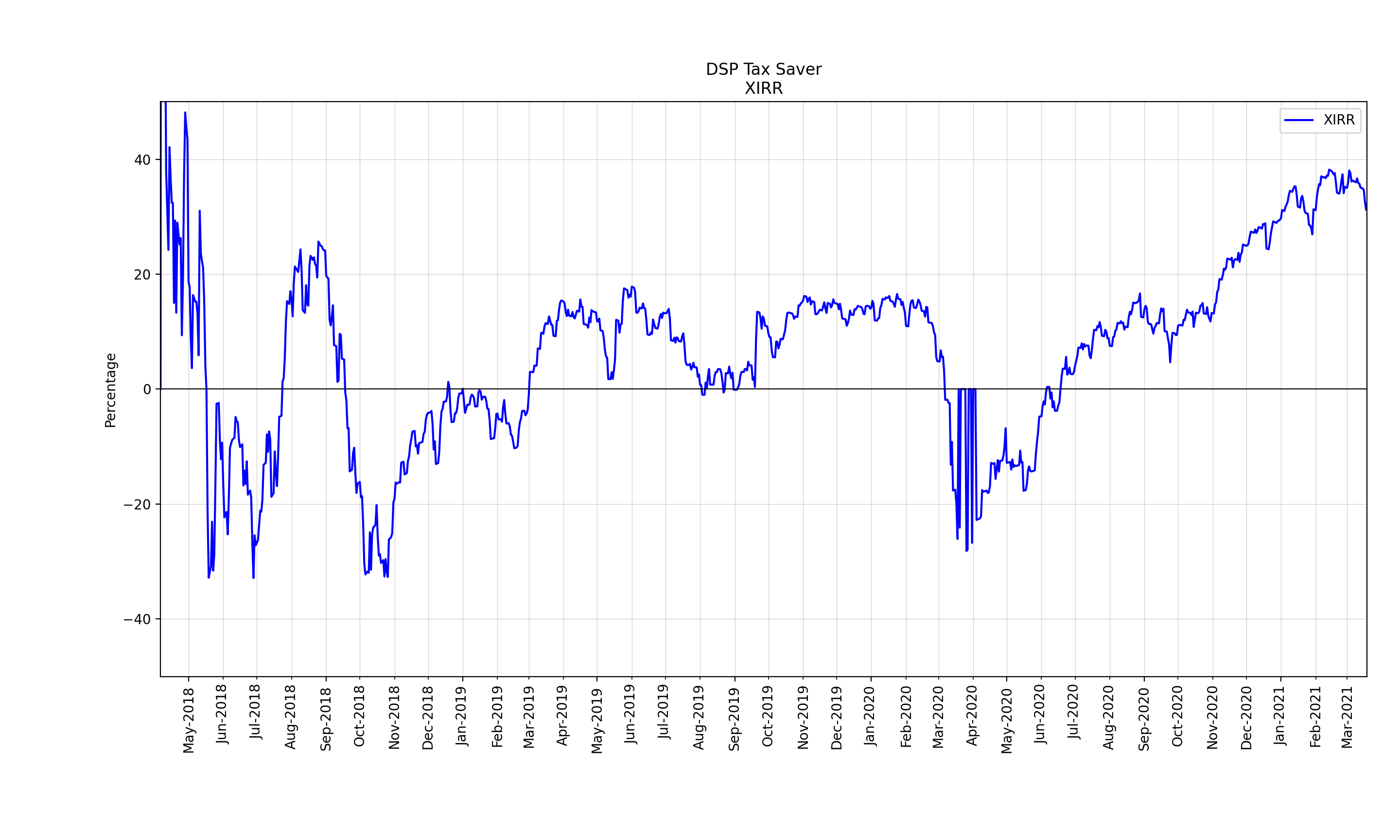
    XIRR Chart

    The market crash of Mar-Jun 2020 was so bad that the XIRR calculations went bonkers and resulted in 0% values for sometime during Mar-Jun 2020. From Mar 2020 to Mar 2021 the XIRR has gone from ~-30% to ~+30%.

    L&T Tax Advantage Fund

    SIP Return Chart

    Similar to DSP Tax Saver, from Mar to Jul 2020, I invested additional fund as lumpsum. But the returns in L&T Tax Advantage were always inferior to DSP Tax Saver. That resulted in me pouring more money in DSP Tax Saver.

    Profit Chart

    During the market crash of Mar-Jun 2020, two years worth of my investments went down by ~35%. But as of Mar 2021, I am looking at a profit of ~30%.

    XIRR Chart

    Similar to DSP Tax Saver, the market crash from Mar to Jun 2020 caused the XIRR calculations to go bonkers and resulted in 0% values for sometime. From Mar 2020 to Mar 2021 the XIRR has gone from ~-30% to ~+20%.

  • Get MUTF_IN codes for mutual fund to use in GOOGLEFINANCE function in Google Sheets

    Update 30-Jul-2023

    I am not sure if this was already there, but when I wrote this blog I couldn’t find this option. The below post becomes excessive in light of this new information.

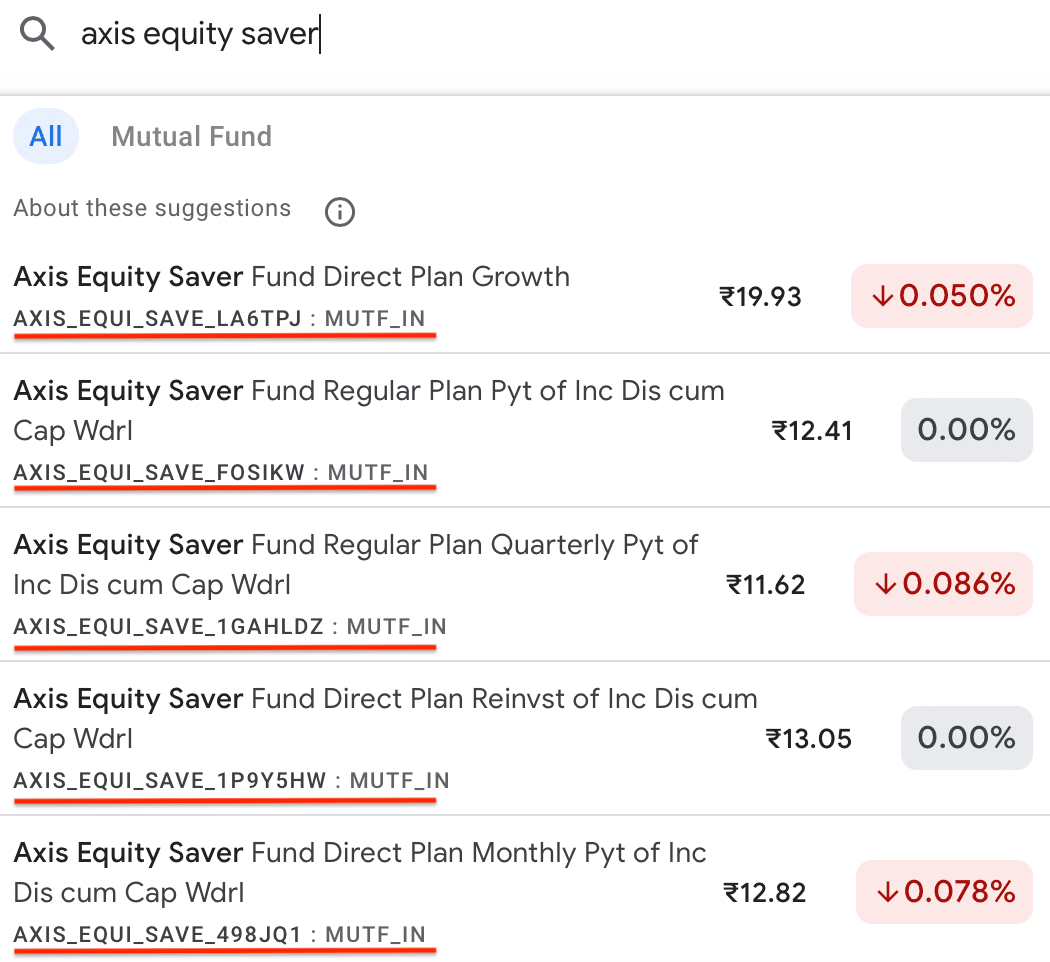
    Go to https://www.google.com/finance/ and start searching for the mutual fund. The search results in the dropdown and page shows the MUTF_IN code. And that’s it!

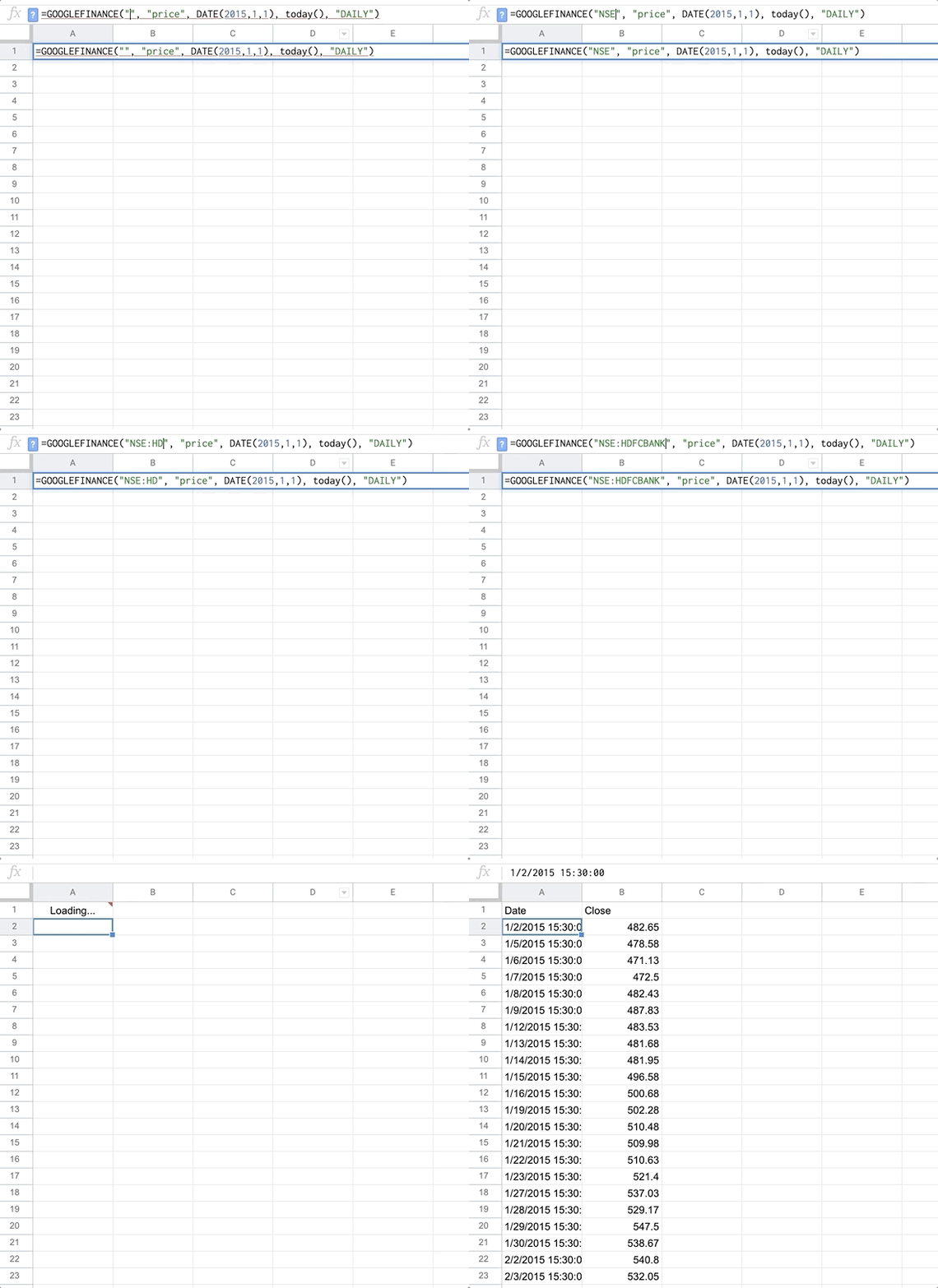
    I have been searching for a long time on how to get the MUTF_IN code for Indian mutual funds. It has been a hit-and-miss for me trying to search on Google. Finally, I think, I figured out a sure shot way to get the MUTF_IN code.

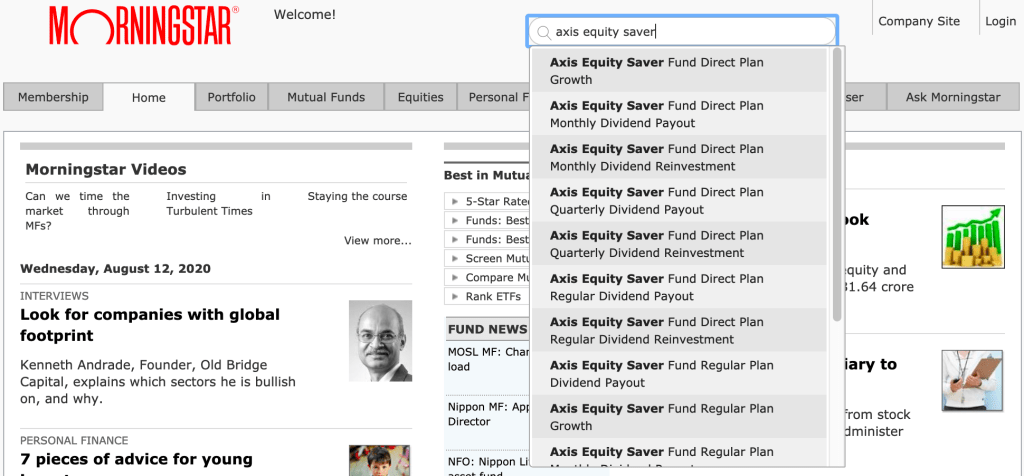
    Go to Morning Star India. Search for your mutual fund in the search box and go to the search result page.

    Get the name of the mutual fund as it appears in the Morning Star page. For some reason Morning Star does not allow you to copy text from its site so you will have to type it. For those who are aware about Inspect Element I don’t think I need to say anything else.

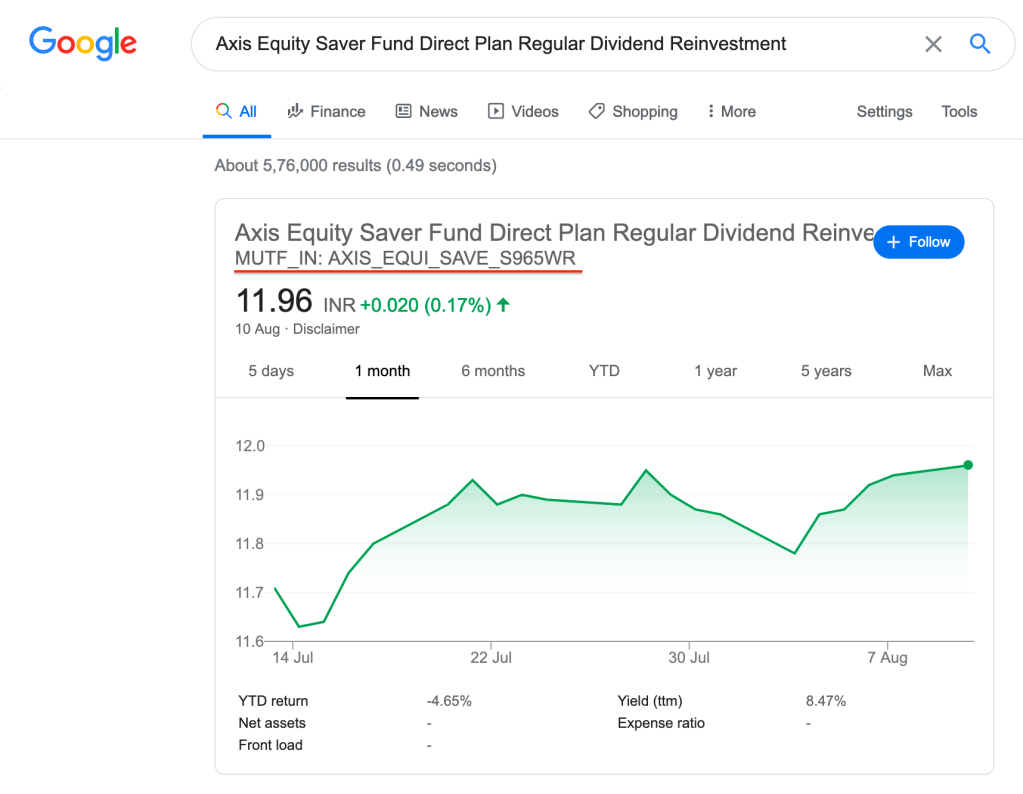
    Type this name in Google search and you should get MUTF_IN code. You can then use the MUTF_IN code in the GOOGLEFINANCE in Google Sheets.

    Additional points to note

    1. This seems to work only for equity funds. Not debt or arbitrage funds (honestly, I don’t even know what an arbitrage fund is).
    2. If there is an hyphen (-) in the name of mutual fund as per Morning Star India, add space before and after it when searching it on Google.